

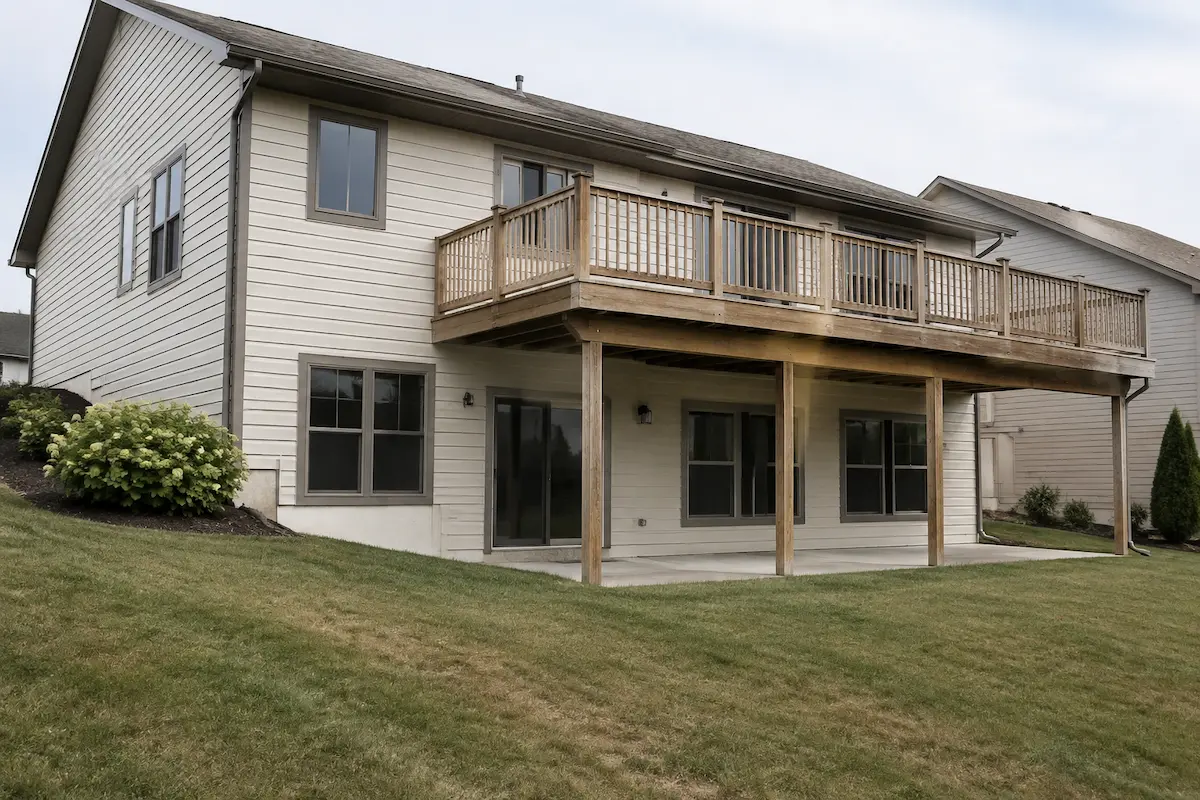
Not as living area. Under the measurement standard appraisers are required to use, finished space below grade is reported separately from the square footage that appears at the top of a listing. The rule that surprises people: if any portion of a level sits below grade, the entire level is classified as below grade, including a walkout with three walls fully exposed. Your eight hundred finished square feet are real. They are just not the same number.
Does a walkout basement count as square footage in Georgia?
No, and this is the single most expensive misunderstanding in North Georgia housing. Terrain here produces daylight and walkout basements at a rate most of the country does not see, which means a large share of Cherokee County inventory carries finished space that does not count toward gross living area.
A walkout feels like a first floor. It has doors to the yard, full windows, natural light, and often better finishes than the rest of the house. None of that changes the classification. Grade is measured against the earth, not against how the room feels when you stand in it.
Why are basements not included in square footage?
Because the measurement standard requires above-grade and below-grade areas to be reported separately, so that two houses can be compared on the same basis. Fannie Mae requires appraisers to follow the ANSI Z765 standard on most one-unit appraisals, which is why this is consistent from one appraiser to the next rather than a matter of opinion.
The purpose is comparison, not judgment. If below-grade space were folded into one total, a 2,000 square foot house on a slab and a 2,000 square foot house with half of it underground would look identical on paper and appraise against each other. They are not the same product and they do not sell for the same price.
This produces a situation that confuses nearly every seller: your house has three different official square footage numbers, and all three can be correct.
| Source | What it measures | Why it differs |
|---|---|---|
| County tax assessor | The county’s own methodology for assessment purposes | Not ANSI. Records may be decades old and may never have been updated after a renovation |
| MLS listing | Separate fields for above-grade and below-grade finished area | Entered by the listing agent. Accuracy depends entirely on who measured and how |
| Appraisal | ANSI measurement of above-grade living area, with below-grade reported separately | This is the number your buyer’s lender relies on |
The third one is the only one that has to be right for the transaction to close.
What makes a basement count as square footage?
Nothing, if it is below grade. Level classification is determined by grade, not by finish quality, ceiling height, permits, or how the space is used.
What those things do affect is whether the finished area is reported as finished at all. Space that generally qualifies as finished below-grade area shares the characteristics of the rest of the house:
- Heated and cooled by the home’s system
- Finished walls, floors, and ceilings comparable to the upper levels
- Legal ceiling height
- Permitted work, where permits were required
- Accessible by a conventional staircase
A partially finished basement with exposed joists in half of it, a space heater, and a plywood floor is not going to be reported the same way as a fully finished lower level, and an appraiser will note the distinction.
How much value does a finished basement add to an appraisal?
It adds value, and at a lower rate per square foot than above-grade area. There is no fixed ratio and any percentage you find quoted as a rule should be ignored, because the appraiser derives it from paired sales in your specific market rather than from a formula.
That last part matters in Cherokee County more than it would elsewhere. When most comparable homes also have finished basements, the market has already priced that feature and the adjustment is well supported. When your house is the only one on the street with a finished lower level, there is less local evidence to support a large adjustment, which tends to compress it.
Why is below grade square footage valued less?
Because buyers pay less for it, and appraisers measure what buyers do rather than deciding what they should do. Below-grade space typically has fewer windows, less natural light, more moisture exposure, and lower ceiling height, and it competes poorly against the same square footage upstairs.
For sellers, the practical consequence arrives at pricing. If you calculate your asking price by multiplying total finished square footage, basement included, by a neighborhood price per square foot, you will land high. Sometimes dramatically. And you will find out during the appraisal, which is the most expensive possible moment to learn it. Here is what happens when that number comes in below the contract price.
Measure before you price. Or at minimum, know which of your three square footage numbers you are using,